When Breast Cancer Feels Emotionally Overwhelming: Coping with Advice, Expectations and Social Pressure
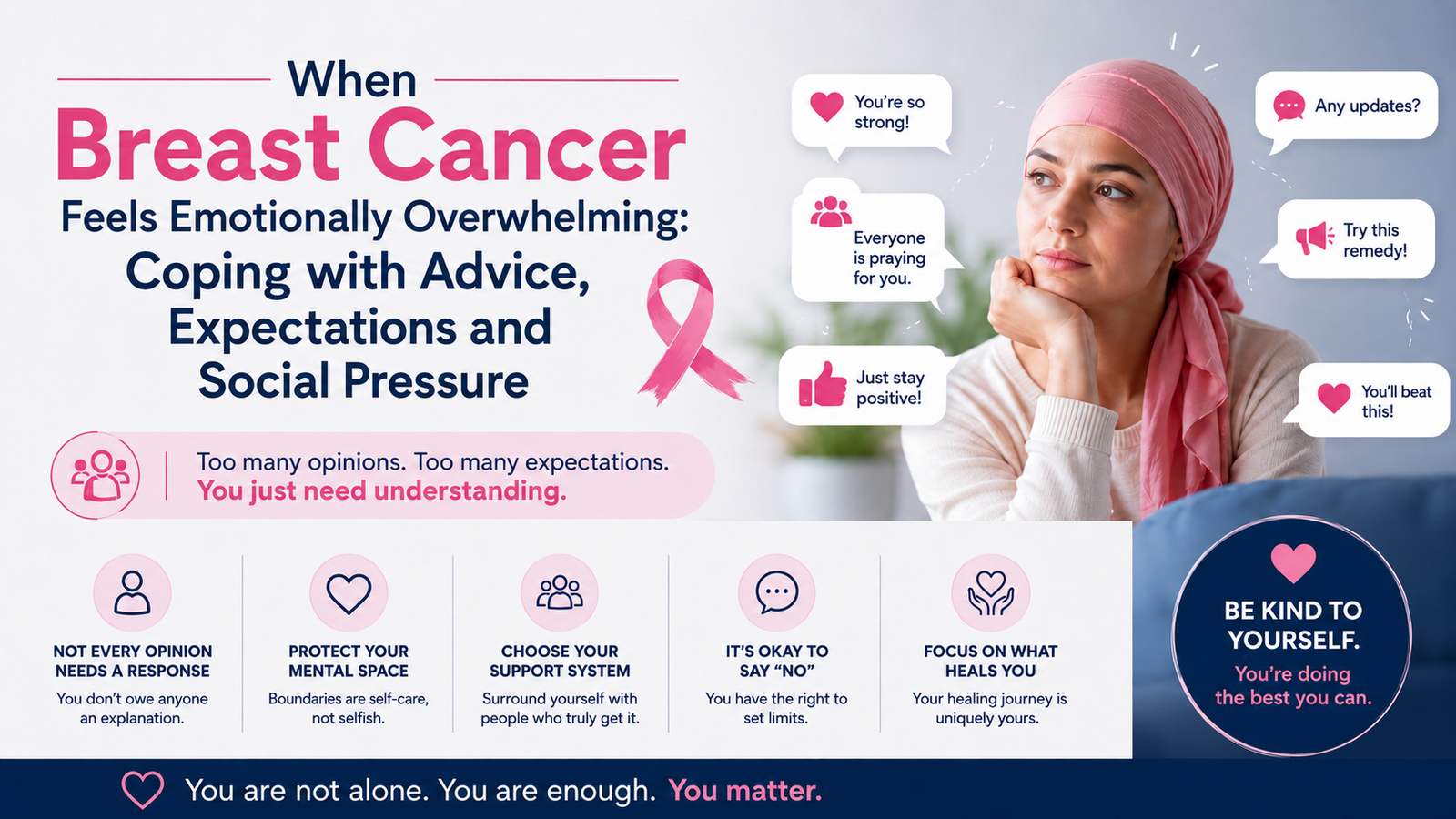
A breast cancer diagnosis changes many things. Appointments appear on the calendar. Conversations become more serious. Life starts getting measured in scans, reports, treatment dates, and follow-ups.
“Am I allowed to feel overwhelmed by people trying to help me?”
The answer is yes.
But there’s another change that often arrives quietly—and catches many people completely off guard. Suddenly, everyone has something to say. Messages begin pouring in. Advice comes from every direction. People ask questions they never asked before. Some become extra protective. Some disappear. Some expect updates. Some expect strength.
Somewhere between being cared for and being observed, many people begin to feel emotionally crowded. While the physical effects of breast cancer are often discussed, the emotional and social challenges receive much less attention. Yet for many patients, they can be just as difficult to navigate.
What Is Social Overwhelm During Breast Cancer?
Social overwhelm is the emotional exhaustion that can happen when advice, concern, expectations and constant attention become difficult to process.
It doesn’t mean you’re ungrateful.
It doesn’t mean you don’t appreciate support.
It simply means that going through something deeply personal while being socially visible can feel exhausting.
Breast cancer often changes more than your treatment plan—it changes the way people interact with you. Sometimes, that emotional burden can feel heavier than expected.
When Everyone Has an Opinion
Soon after diagnosis, you may hear things like:
- “My neighbour had exactly the same cancer.”
- “Don’t take chemotherapy.”
- “Try this herb instead.”
- “Biopsy spreads cancer.”
- “My relative got cured naturally.”
Remember,
Every breast cancer is different. Your treatment should be based on your diagnosis, your stage of disease, and your treating team’s recommendations—not someone else’s experience.
When Support Accidentally Becomes Pressure
Support usually comes with good intentions. But intentions and impact are not always the same. Many patients describe experiences like:
- Feeling responsible for reassuring everyone else.
- Repeating medical updates over and over again.
- Receiving endless unsolicited advice.
- Being expected to stay positive all the time.
- Feeling guilty for needing space.
- Being treated differently after diagnosis.
One of the strangest parts?
You may feel lonely and overwhelmed at the same time. That experience is much more common than most people realise.
The Pressure to Be "Strong"
One sentence that many patients hear is: “You’re so strong.”
Although it is meant as encouragement, it sometimes creates another burden. Suddenly, people expect strength every single day.
But strength does not mean:
- Never crying.
- Never feeling scared.
- Never feeling tired.
- Pretending everything is fine.
Sometimes strength means asking difficult questions. Sometimes it means cancelling plans. Sometimes it means saying, “I don’t want to talk about cancer today.” And that counts too.
The Guilt That Nobody Talks About
Many patients quietly carry a sense of guilt.
They worry about the financial burden, the disruption to family life, or the time their loved ones are spending caring for them.
These feelings are common—but they are not a reflection of reality.
Cancer is not your fault, and accepting help does not make you a burden.
It simply allows the people who love you to support you through one of life’s most difficult moments.
The i-bocc 7 Reminders During Breast Cancer Treatment
✓ Trust your treating team more than the internet.
✓ Not every story on social media is your story.
✓ Not every opinion deserves equal emotional space.
✓ You don’t owe everyone constant updates. Protecting your peace is not being rude.
✓ Accept help without guilt. It does not make you a burden.
✓ Strength includes asking for help, crying, and taking breaks.
✓ Focus on today’s step—not the entire journey.
Breast Cancer Is Personal—Even When It Feels Public
Breast cancer can unexpectedly make your private world feel public. But your diagnosis does not become public property. You do not owe constant updates. You do not owe positivity. You do not owe inspiration.
You are allowed to move through treatment in a way that protects your energy and feels right for you.
Across Chhatrapati Sambhajinagar, Jalna, Beed, Parbhani, Nanded, Hingoli, Latur, Buldhana, Jalgao and surrounding districts, we meet many women who quietly carry this emotional burden while focusing on treatment. Feeling overwhelmed does not mean you are weak—it means you are human.
Healing is not only physical.
Sometimes healing also means learning which voices deserve space—and which ones don’t.
A Message I Often Share With My Patients
For many patients diagnosed with early-stage breast cancer, I often say:
“Over the next few weeks, you will hear a lot of noise. Some of it will come from your own fears, and some of it will come from well-meaning family, friends, neighbours, WhatsApp messages, YouTube videos, and stories from other patients.”
“Whenever you feel overwhelmed, come back to one simple thought: ‘My doctor has told me that if I complete my treatment, my cancer is curable, and I don’t have to lose my breast.’ Everything else is temporary.”
Patients often tell me that remembering this one thought helps them stay focused on what truly matters.
Common Myths About Emotional Health During Breast Cancer
Myth: I should stay positive all the time.
Fact: It is completely normal to experience fear, sadness, anger and uncertainty. Emotional honesty is healthier than pretending everything is fine.
Myth: Crying means I’m weak.
Fact: Expressing emotions is a normal part of coping and does not affect your treatment or recovery.
Myth: I shouldn’t burden my family.
Fact: Accepting help allows the people who love you to support you during a difficult time.
Myth: Every patient with breast cancer has the same journey.
Fact: Every diagnosis, treatment plan and recovery experience is unique.
Myth: I found a miracle treatment on YouTube or WhatsApp.
Fact: Always discuss treatment decisions with your oncology team. Many online claims are not supported by scientific evidence and may delay effective treatment.
Frequently Asked Questions (FAQs)
01. Is it normal to feel emotionally overwhelmed after a breast cancer diagnosis?
Yes. Many people experience emotional and social overwhelm while navigating treatment, conversations and changing routines.
02. How can patients set boundaries during breast cancer treatment?
You can choose how often to update people, politely decline discussions when you’re tired, and communicate your needs honestly. Setting boundaries protects your emotional wellbeing.
03. Can social support become overwhelming?
Yes. Support is valuable, but constant communication, unsolicited advice and expectations can sometimes become emotionally exhausting.
04. Should mental health support be considered during breast cancer treatment?
Absolutely. Emotional wellbeing is an important part of cancer care. Counselling, support groups or simply speaking openly with your treating team can make a meaningful difference.
05. Is it okay to not talk about cancer all the time?
Yes. You are allowed to take breaks from cancer-related conversations and continue enjoying the parts of life that make you feel like yourself.
Need Support?
Breast cancer treatment is about more than surgery, chemotherapy or radiation therapy. Looking after your emotional wellbeing is equally important.
If you are finding the emotional burden of breast cancer difficult to cope with, speak openly with your treating team. Asking for help is not a sign of weakness—it is an important part of healing.
Disclaimer
Readers should not treat any information in this blog as medical advice for their condition. It is very important that an in-person consultation be conducted with an expert before taking any medication or treatment.