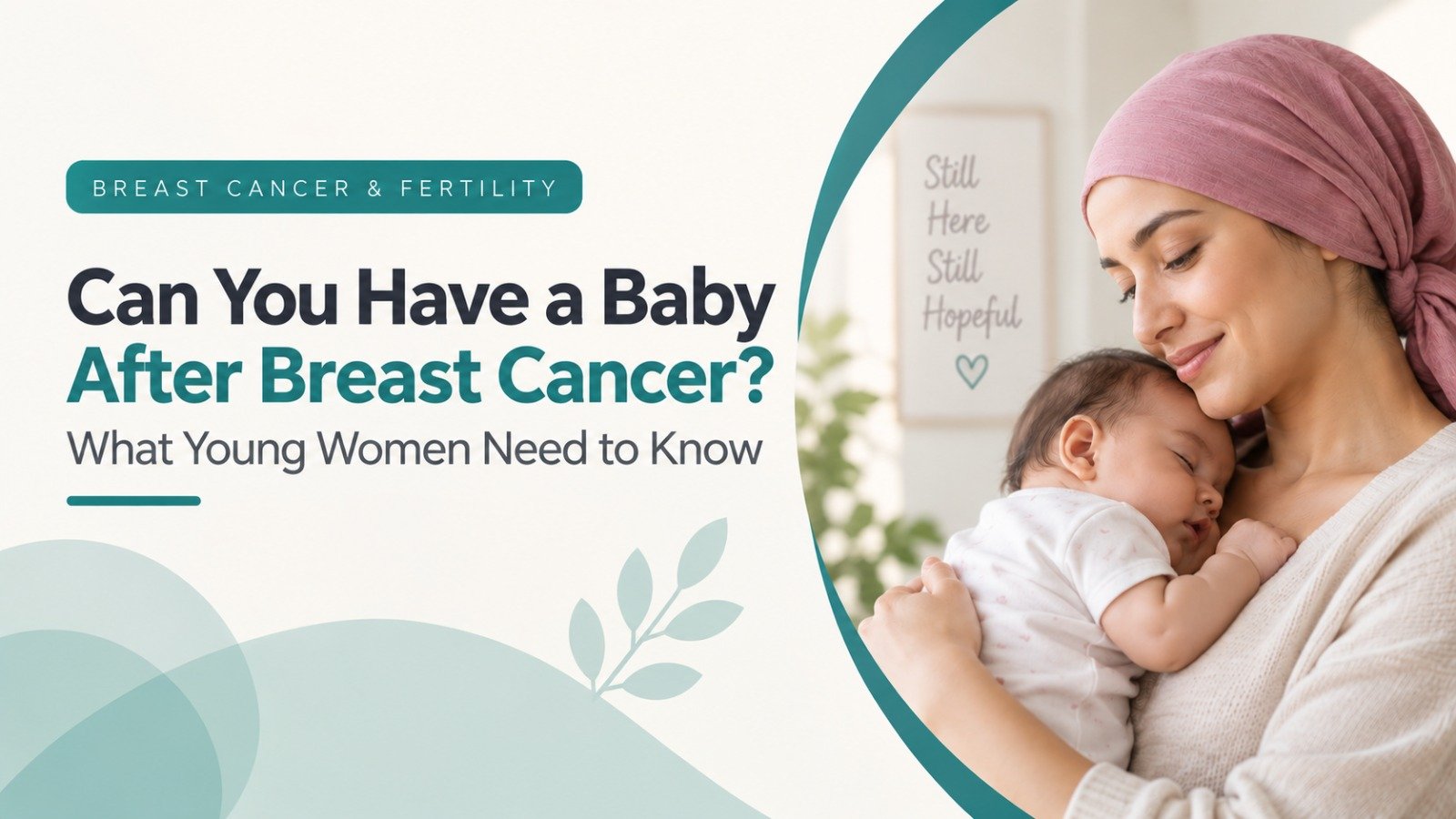
Can You Have a Baby After Breast Cancer? What Young Women Need to Know
A breast cancer diagnosis can make the future suddenly feel uncertain.
Will I need chemotherapy?
Will I lose my breast?
Will the cancer come back?
But for a young woman, there may be another question that feels just as important:
“Will I ever be able to have a baby?”
It’s a question many women hesitate to ask.
But it is a question worth asking before cancer treatment begins.
Can breast cancer affect fertility?
Some breast cancer treatments, particularly certain chemotherapy medicines, can affect the ovaries.
For some women, ovarian function may recover after treatment.
For others, treatment may significantly reduce fertility or bring menopause earlier than expected.
And age matters too.
This is why fertility shouldn’t be treated as an afterthought.
If having biological children is important to you, it should be part of your cancer treatment discussion from the beginning.
Why should you talk about fertility before chemotherapy?
Because some fertility-preservation options need to be considered before treatment starts.
Depending on your individual circumstances, your oncology team may refer you to a fertility specialist.
Possible options can include:
Egg freezing
Eggs can be collected and frozen for possible future use.
Embryo freezing
Eggs can be fertilised and the resulting embryos can be frozen.
Other fertility-preservation approaches
Depending on your age, cancer type, treatment plan and ovarian reserve, other strategies may also be considered.
The important thing is timing.
You don’t need to know all the answers immediately.
But you do need to start the conversation early.
What if you have already been diagnosed?
Don’t assume that fertility preservation is no longer possible.
Talk to your oncologist.
Your treatment urgency, cancer subtype and planned therapy will determine what options are realistic.
The cancer treatment plan always needs to remain the priority, but that doesn’t mean your future reproductive goals should be ignored.
Can you become pregnant after breast cancer?
For many women, pregnancy after breast cancer may be possible.
But it should be planned carefully.
Doctors may consider:
- The type of breast cancer
- Stage of the disease
- Treatments received
- Current medications
- Hormone receptor status
- Risk of recurrence
- Recovery of ovarian function
- Overall health
Pregnancy planning therefore isn’t simply about asking:
“How long should I wait?”
It’s about asking:
“Is pregnancy safe for me at this point in my treatment journey?”
What if your breast cancer is hormone-sensitive?
This can make the conversation more complicated.
Some women with hormone receptor-positive breast cancer are prescribed endocrine therapy for several years.
If pregnancy is important to them, the timing of treatment and pregnancy may need to be carefully coordinated.
In some situations, doctors may discuss a temporary interruption of endocrine treatment to allow pregnancy.
But this is not a decision to make independently.
It requires careful discussion between the patient, oncologist and reproductive specialist.
Don’t be afraid to talk about motherhood
When you’re diagnosed with cancer, everyone naturally focuses on treating the disease.
And rightly so.
But you’re not just a diagnosis.
You may also be someone who wants to become a mother.
Someone who wants to build a family.
Someone who has plans for the future.
So if fertility matters to you, say it.
Before chemotherapy. Before starting long-term hormonal treatment. Before making assumptions about your future.
Breast cancer may change your plans.
But it doesn’t necessarily mean you have to give up on them.
Sometimes, the most important part of cancer care is not just treating the disease you have today.
It’s also protecting the possibilities you hope for tomorrow.
Disclaimer
Readers should not treat any information in this blog as medical advice for their condition. It is very important that an in-person consultation be conducted with an expert before taking any medication or treatment.