
After Jaw Surgery for Oral Cancer, Can You Eat, Speak and Smile Again?
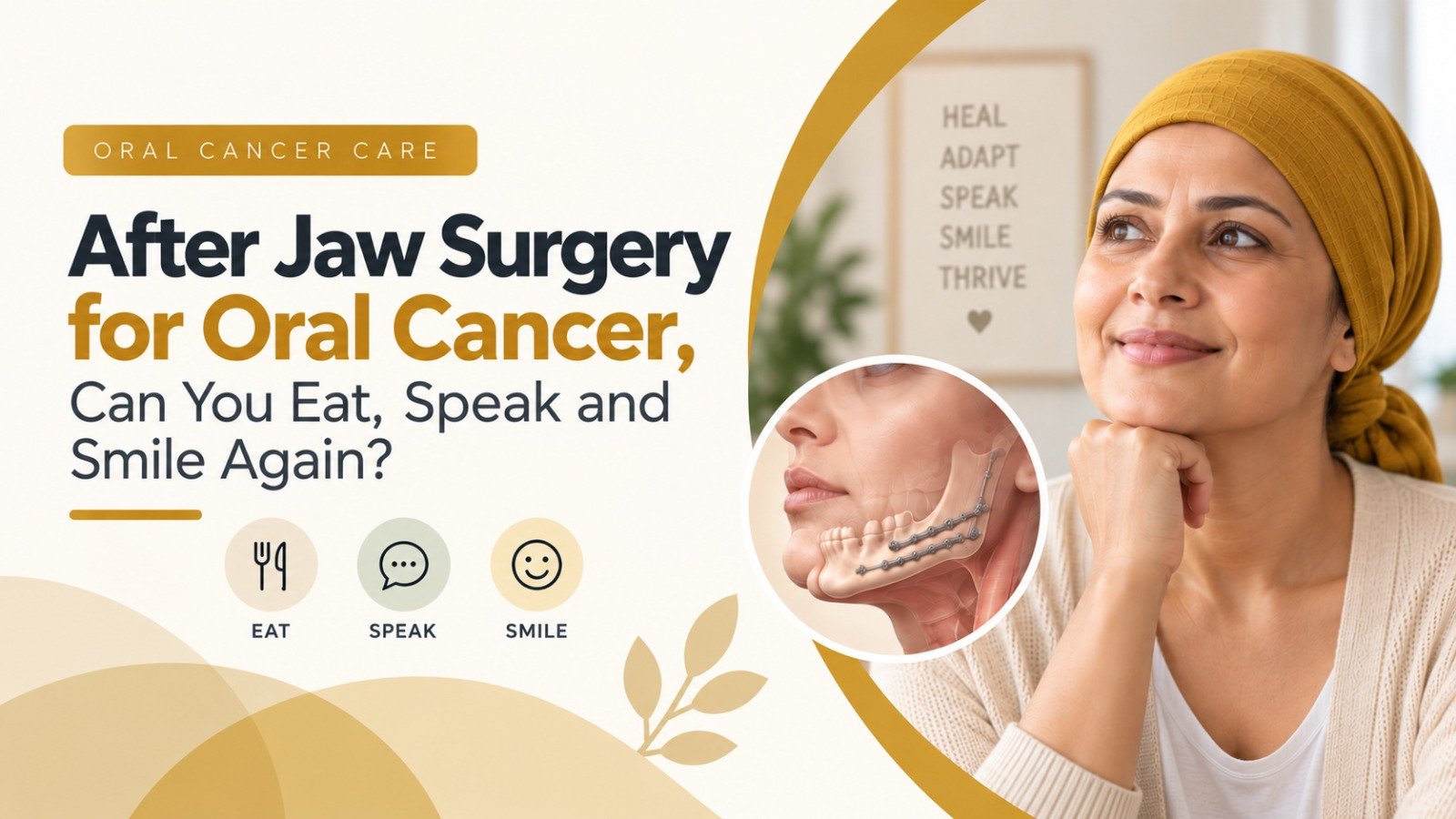
For someone diagnosed with oral cancer, the fear isn’t always just:
“Will I survive?”
Sometimes it’s something much more personal:
“What will happen to my face?”
“Will I be able to eat?”
“Will I be able to speak?”
“Will I still look like myself?”
When oral cancer involves the jaw, tongue, cheek or surrounding structures, removing the cancer may require major surgery.
But removing the cancer is only one part of the story.
The next question is:
How do we rebuild what has been removed?
Why might part of the jaw need to be removed?
If an oral cancer has invaded the jawbone, the surgeon may need to remove the involved portion to achieve adequate cancer clearance.
This is an important part of cancer surgery.
But removing part of the jaw can affect much more than appearance.
It can affect:
- Chewing
- Swallowing
- Speech
- Facial shape
- Dental function
- Jaw movement
This is why reconstruction can be an important part of the overall treatment plan.
Reconstruction isn’t just about looks
When people hear “reconstructive surgery,” they may imagine cosmetic surgery.
But reconstruction after oral cancer is fundamentally about restoring function as well as appearance.
Depending on the defect, reconstruction may use tissue from another part of the patient’s body.
In complex cases, surgeons may use microvascular free-flap reconstruction, where tissue along with its blood supply is transferred to rebuild the affected area.
For jaw reconstruction, bone from another part of the body may sometimes be used to recreate the missing section of the jaw.
Why rebuild the jaw?
Because the jaw does a lot more than create facial structure.
It plays an important role in:
Chewing.
Speaking.
Supporting teeth.
Maintaining facial symmetry.
Supporting normal oral function.
So reconstruction is planned with the patient’s life after surgery in mind.
But surgery is not the end
This is something patients should know before undergoing major cancer surgery.
Reconstruction can restore anatomy.
But the patient may still need rehabilitation to regain function.
This can include:
- Speech therapy
- Swallowing therapy
- Jaw-opening exercises
- Physiotherapy
- Nutritional support
- Oral rehabilitation
- Dental rehabilitation when appropriate
Recovery doesn’t happen overnight.
It is a process.
Can teeth be replaced after jaw reconstruction?
In selected patients, dental rehabilitation can become part of the longer-term recovery plan.
But whether and when dental rehabilitation is possible depends on factors such as:
- The extent of surgery
- Type of reconstruction
- Healing
- Radiation treatment
- Remaining teeth
- Bone condition
- Overall health
The goal isn’t simply to put teeth back.
It’s to restore useful, comfortable oral function wherever possible.
What about the way the face looks?
Modern reconstructive surgery aims to restore facial contour and symmetry as well as possible.
But patients should also understand that recovery takes time.
Immediately after major surgery, swelling can make the face look very different.
As healing progresses, swelling reduces and tissues settle.
Scar appearance also changes over time.
The final result should therefore not be judged in the first few days or weeks.
Can patients really eat and speak again?
Many patients can regain meaningful oral function after major head and neck cancer surgery, but the outcome depends on the cancer, extent of surgery, reconstruction, other treatments and rehabilitation.
There is no single recovery timeline that applies to everyone.
Some patients progress quickly.
Others need months of rehabilitation.
What matters is having a treatment plan that considers life after cancer, not just cancer removal.
Because the real goal is bigger than removing a tumour
Cancer surgery should answer one question:
“How do we remove the cancer safely?”
Reconstruction asks another:
“How do we rebuild what was lost?”
And rehabilitation asks the question patients often care about most:
“How do I get my life back?”
Can I eat with my family?
Can I speak confidently?
Can I smile without hiding my face?
Can I return to work?
Can I feel like myself again?
That is the bigger picture of modern head and neck cancer care:
Remove the cancer. Rebuild what is lost. Restore what matters.
Because surviving oral cancer is not the end of the journey.
Getting back to living is.
Disclaimer
Readers should not treat any information in this blog as medical advice for their condition. It is very important that an in-person consultation be conducted with an expert before taking any medication or treatment.