
Stages of Head & Neck Cancer: What Does Stage 1, 2, 3 or 4 Really Mean?
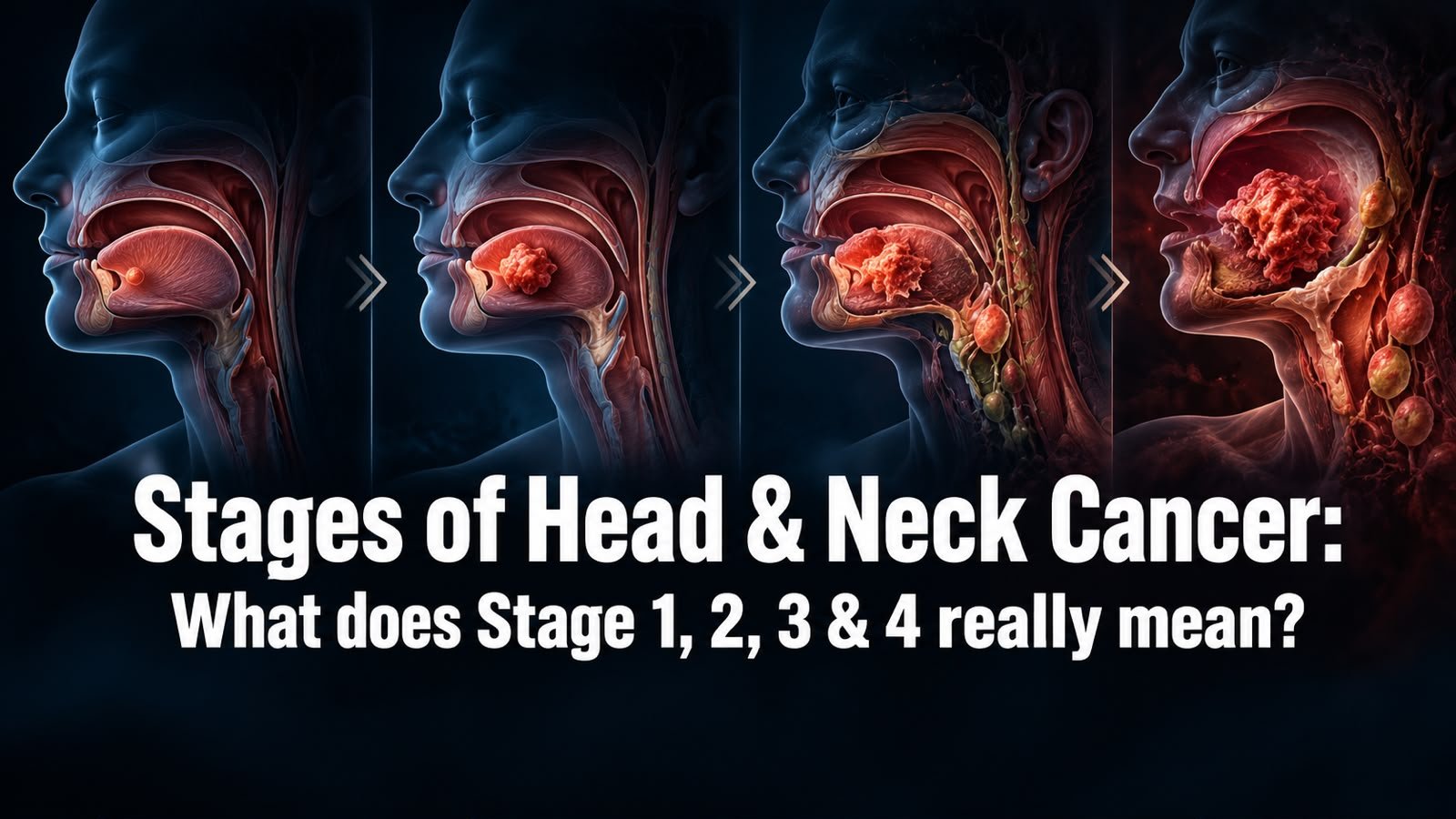
Hearing the words “You have head and neck cancer” is frightening enough.
Then comes another word that can feel even more confusing:
“Stage.”
Stage 1. Stage 2. Stage 3. Stage 4.
But what do these numbers actually mean?
Cancer staging is not simply a measure of how “bad” a cancer is. It helps doctors understand where the cancer is, how large it is, whether lymph nodes are involved and whether it has spread to other parts of the body.
Understanding your cancer stage can make an overwhelming diagnosis a little easier to understand.
What Is Head & Neck Cancer Staging?
Head and neck cancer is not one single disease. It can develop in different areas, including the mouth, tongue, throat, tonsils, voice box, nasal cavity and salivary glands.
Because cancers in different locations can behave differently, staging depends on the site and type of cancer.
Doctors commonly use the TNM staging system:
T = Tumour
How large the primary tumour is and how far it has grown into nearby structures.
N = Nodes
Whether nearby lymph nodes contain cancer and, if so, their number, size and location.
M = Metastasis
Whether the cancer has spread to distant organs.
These findings are combined to determine the overall stage.
Stage 1: An Early Cancer
Stage 1 generally describes a smaller, localized cancer without significant spread to nearby lymph nodes or distant organs.
This is why early detection matters.
A persistent mouth ulcer, unexplained lump, voice change, difficulty swallowing or non-healing lesion should not simply be ignored because it is painless.
Early symptoms can sometimes look surprisingly ordinary.
Stage 2: Still Localized, But Larger
Stage 2 usually represents a tumour that is larger than a stage 1 tumour, while remaining relatively localized.
The exact criteria vary depending on where the cancer began.
This is an important point:
The same stage number does not necessarily mean exactly the same thing for every head and neck cancer.
Your oncologist considers the cancer’s exact location, pathology and staging details before discussing treatment.
Stage 3: More Extensive Disease
Stage 3 may indicate a larger or more locally advanced tumour and/or involvement of certain nearby lymph nodes.
At this point, treatment planning may become more complex.
Depending on the cancer, treatment can involve surgery, radiation therapy, chemotherapy, targeted therapy or immunotherapy, sometimes in combination.
But remember:
Stage 3 does not automatically mean “nothing can be done.”
Many factors—not just the stage number—matter when doctors plan treatment.
Stage 4: Advanced Head & Neck Cancer
Stage 4 can describe different situations.
A cancer may have grown extensively into nearby structures or involved certain lymph nodes. In some cases, stage 4 indicates that the cancer has spread to distant organs, which is known as metastatic cancer.
Therefore, saying simply “Stage 4” does not tell the entire story.
Your doctor will explain whether the cancer is locally advanced or metastatic, because these situations can require different treatment approaches.
Why Stage Isn’t the Whole Story
Two people can have the same cancer stage but receive different treatment plans.
Why?
Because doctors also consider:
- Exact cancer location
- Tumour size and spread
- Lymph node involvement
- Biopsy and pathology findings
- HPV status in certain oropharyngeal cancers
- Overall health
- Previous treatment
- Whether the cancer is newly diagnosed or recurrent
- The patient’s goals and preferences
This is why comparing your diagnosis directly with someone else’s experience can sometimes create unnecessary fear.
Ask Your Oncologist These Questions
After receiving a diagnosis, take notes—or bring someone you trust to the appointment.
Ask:
“What is my exact cancer type?”
“Where exactly has the cancer spread?”
“What is my TNM stage?”
“Are my lymph nodes involved?”
“Is the cancer locally advanced or metastatic?”
“What are my treatment options?”
Understanding your diagnosis is not about memorising medical terminology.
It is about knowing what is happening inside your body and why your medical team is recommending a particular treatment.
The Bottom Line
Cancer stage is a map—not a prediction of your entire future.
It helps the medical team understand the extent of disease and plan treatment.
If you have been diagnosed with head and neck cancer, don’t let a number define your journey.
Understand the stage.
Understand the treatment.
And most importantly, understand your individual cancer.
Disclaimer
Readers should not treat any information in this blog as medical advice for their condition. It is very important that an in-person consultation be conducted with an expert before taking any medication or treatment.