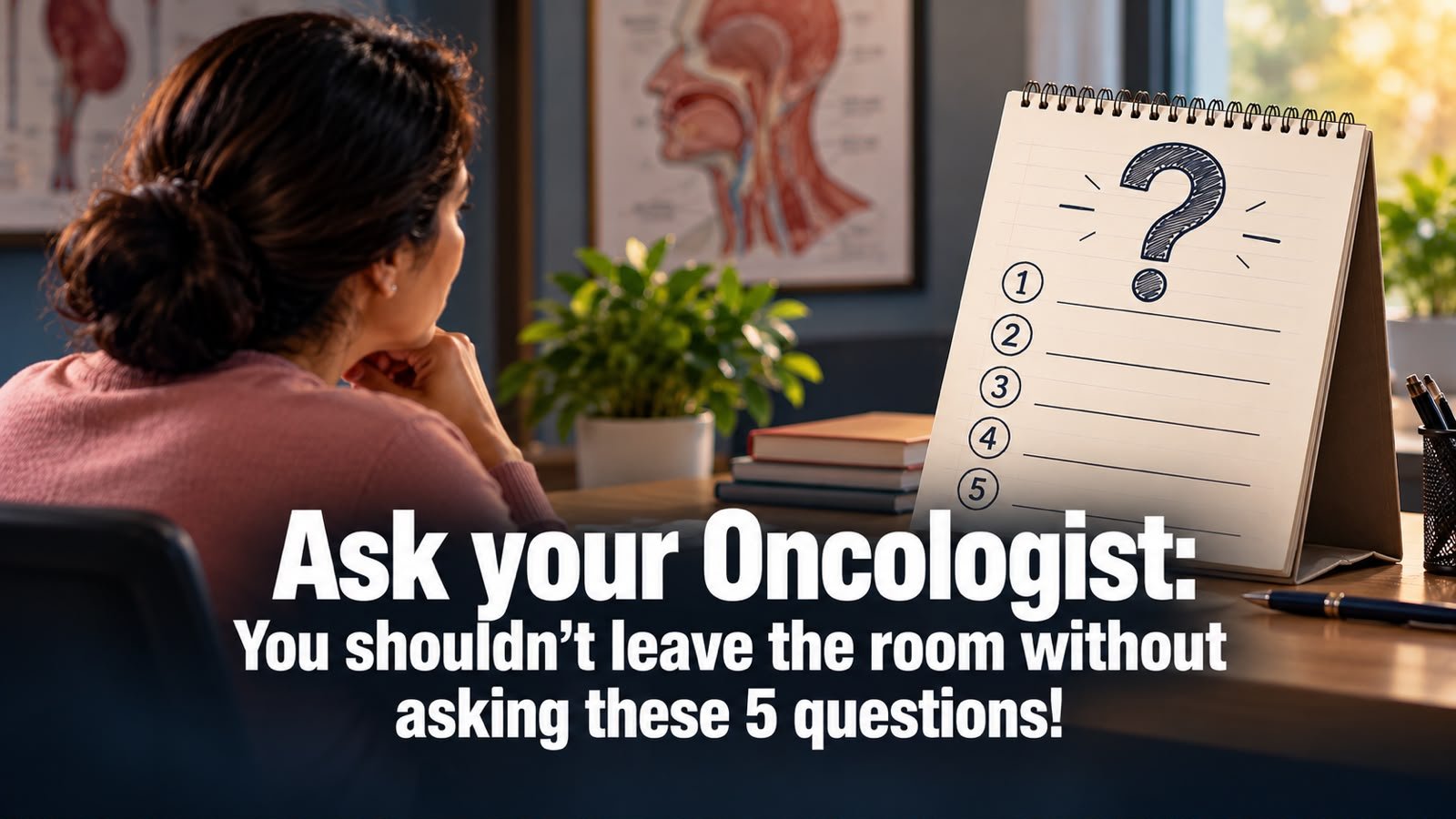
ASK YOUR ONCOLOGIST: You Shouldn’t Leave the Room Without Asking these 5 questions
You have just been diagnosed with head and neck cancer.
Your doctor is explaining the biopsy, scans, treatment options and next steps.
You are listening.
But inside your head, there may be only one thought:
“What does all of this mean for me?”
Cancer appointments can be overwhelming. It is completely normal to forget questions or struggle to process medical terminology in the moment.
So before your next head and neck cancer consultation, save these five questions.
1. “What Exactly Is My Cancer and Where Is It Located?”
“Head and neck cancer” is a broad term.
Cancer can develop in the mouth, tongue, throat, tonsils, voice box, nasal cavity, salivary glands and other areas.
Ask your oncologist to explain exactly:
- Where the cancer started
- What type of cancer it is
- How large it is
- Whether nearby tissues are involved
- Whether lymph nodes are affected
Understanding the location and type of cancer is the starting point for understanding your treatment.
2. “What Is My Cancer Stage-and What Does It Mean?”
You may hear terms such as Stage 1, Stage 2, Stage 3 or Stage 4.
But don’t leave the appointment with only a number.
Ask:
“Can you explain my TNM stage in simple language?”
TNM describes the primary tumour, nearby lymph nodes and whether there is evidence of distant metastasis.
Also ask whether your cancer is considered early-stage, locally advanced or metastatic, because these descriptions can influence treatment planning.
A stage number is important-but it is not the entire story.
3. “What Are My Treatment Options?”
Don’t be afraid to ask about the complete treatment plan.
Depending on the individual cancer, treatment may involve head and neck cancer surgery, radiation therapy, chemotherapy, targeted therapy or immunotherapy.
Ask your oncologist:
“Why are you recommending this treatment for me?”
You can also ask:
“Will I need one treatment or a combination?”
“How long will treatment take?”
“What side effects should I prepare for?”
Understanding the reason behind a treatment can make the process feel less uncertain.
4. “How Could Treatment Affect My Everyday Life?”
This question is often overlooked.
Head and neck cancer treatment can potentially affect speech, swallowing, eating, taste, saliva, dental health, appearance and nutrition.
Ask what you should expect before treatment begins.
You can ask:
“Will I need speech or swallowing rehabilitation?”
“Should I see a nutrition specialist?”
“Do I need a dental evaluation before treatment?”
“Could treatment affect my ability to eat or speak?”
Knowing what may happen allows you and your family to prepare rather than being surprised later.
5. “What Should I Do After Treatment?”
Treatment ending is not the end of the conversation.
Ask your oncologist about your head and neck cancer follow-up care, including:
- How often you need follow-up visits
- Which symptoms should be reported
- When scans or tests may be required
- Rehabilitation
- Nutrition
- Tobacco and alcohol cessation
- Emotional and psychological support
- Long-term side effects
And ask one question that can make a major difference:
“What can I do to reduce my risk of future health problems?”
Take Someone With You
If possible, take a family member or trusted person to important cancer appointments.
They can take notes, help remember questions and listen when emotions make it difficult to process information.
You can also keep a dedicated cancer treatment notebook or phone note containing your diagnosis, reports, medications, questions and upcoming appointments.
One More Thing: Don’t Be Afraid to Ask Again
If your oncologist explains something and you still don’t understand it, say so.
“Could you explain that in simpler terms?”
is a perfectly valid question.
You are not expected to become a medical expert overnight.
You simply deserve to understand what is happening to your body.
Your Next Appointment Should Be a Conversation—Not Just a Consultation
Bring your questions.
Take notes.
Ask for clarification.
Understand your options.
And make sure your treating team knows what matters to you-not just what your scan shows.
Because good cancer care is not only about treating the disease. It is also about helping the person living through it understand every step.
Disclaimer
Readers should not treat any information in this blog as medical advice for their condition. It is very important that an in-person consultation be conducted with an expert before taking any medication or treatment.